The Slavic Department offers a range of courses in Polish, Russian, Ukrainian and English. Please take a look at our upcoming course offerings along with a list of other recent and future courses. To sign up for our courses, go to the Course Catalog, and search for Russian, Polish, or Ukrainian.
Jump to current courses in Polish, Russian, Ukrainian, Literature & Culture
Upcoming Slavic Department Courses
(Fall 2026)
Literature & Culture
Every semester we offer a selection of courses on the literature and culture of the region taught in both Russian and English. Most of our literature & culture courses meet the HALM or Diversity Global core requirements.
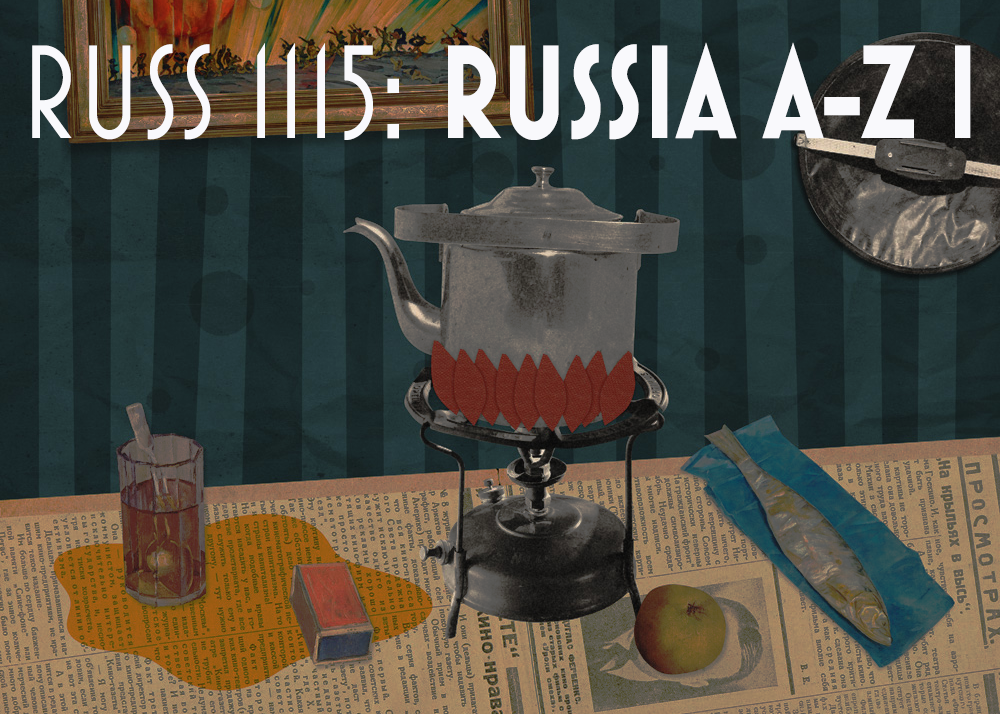
RUSS 1115: Russia A-Z I
Profs. Irina Denischenko, Milla Fedorova, Bradley Gorski, George Mihaychuk & Olga Meerson
Thursday 2:00–2:50 PM
Course Taught in English
This one-credit survey of major topics in Russian culture from its beginnings to the present acquaints students with fields of inquiry in Russian language, literature, linguistics and culture and provides the necessary background for further study. It is intended as an introductory course for interested students with little or no background in these subject areas. The course is team-taught by members of the Department of Slavic Languages. In the final three classes of the semester, professors will report on their individual research. All lectures and readings are in English. (No prerequisites.) (1 credit)
RUSS 4006: Russian Through Culture
Prof. George Mihaychuk
MW 5:00–6:15 PM
Course is Taught in Russian
This course examines the sources of contested issues raised in the present Russian-Ukrainian conflict that were formed from the late 18th-century to the end of the imperial age. How did the two national narratives treat origins in Kyivan Rus, the issue of language, the relationship of empire and peoples, and cultural production. For the empire unity was at stake. For Ukrainians it was not merely existence as a distinctive people but an issue of esteem and worth.Students will analyze original Russian language texts of writers, scholars, and critics of the day. By engaging in oral and written work, they will enhance their vocabulary and language skills. (3 credits)

RUSS 4352 / WGST 3352: Woman with a Movie Camera
Prof. Irina Denischenko
TR 12:30–1:45 PM
Course Taught in English
This course explores the cinematic contributions of women directors, cinematographers, screenwriters, and editors from the Soviet Union and Eastern Europe and their legacies in contemporary cinema. Central to this course is the exploration of Marxist feminism as well as the “Western” feminist concepts of écriture feminine and cinécriture. Examining specific works of art, we will ask: is women’s cinematic writing as a gendered vision of reality possible within a Marxist political-theoretical framework, which sees women’s liberation as part of the broader class struggle? Does women’s “writing” in cinema of the region exist in spite of an overarching framework that minimizes gender differences in favor of the universal human? What did women directors, cinemato-graphers, editors, etc., from this geographic region contribute to cinematic techniques and the language of film? Does women’s cinema of the socialist period continue to inform the film industry in Russia and Central and Eastern Europe today? (3 credits. HALC)
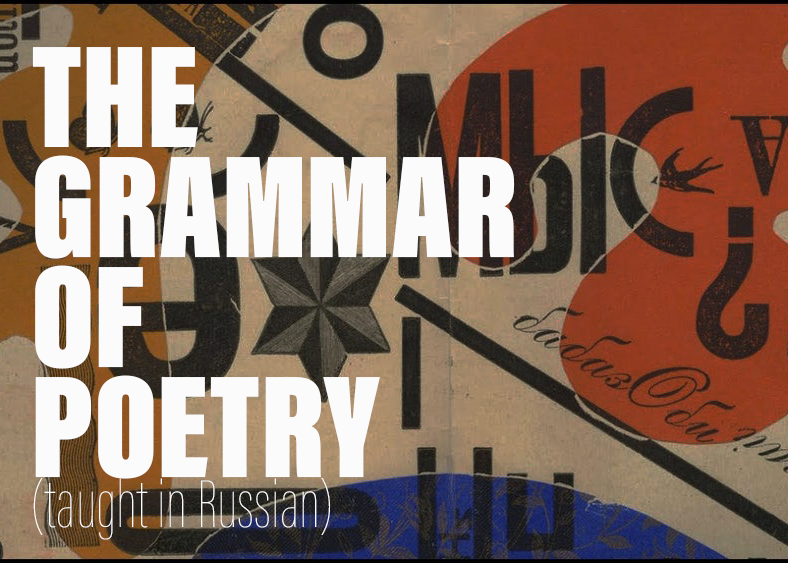
RUSS 4483 : The Grammar of Poetry
Prof. Olga Meerson
MW 2:00–3:15 PM
Course Taught in Russian
This advanced course focuses on the analysis of Russian poetry. It involves close readings, structural analysis, and examination of poetic devices and themes. We begin with contemporary poetry and then move backward to classical texts, tracing how poetic language, imagery, and form evolve across different periods. Through this reverse trajectory, students encounter the tradition not as a static canon but as a living dialogue. Conducted in Russian. (3 Credits)
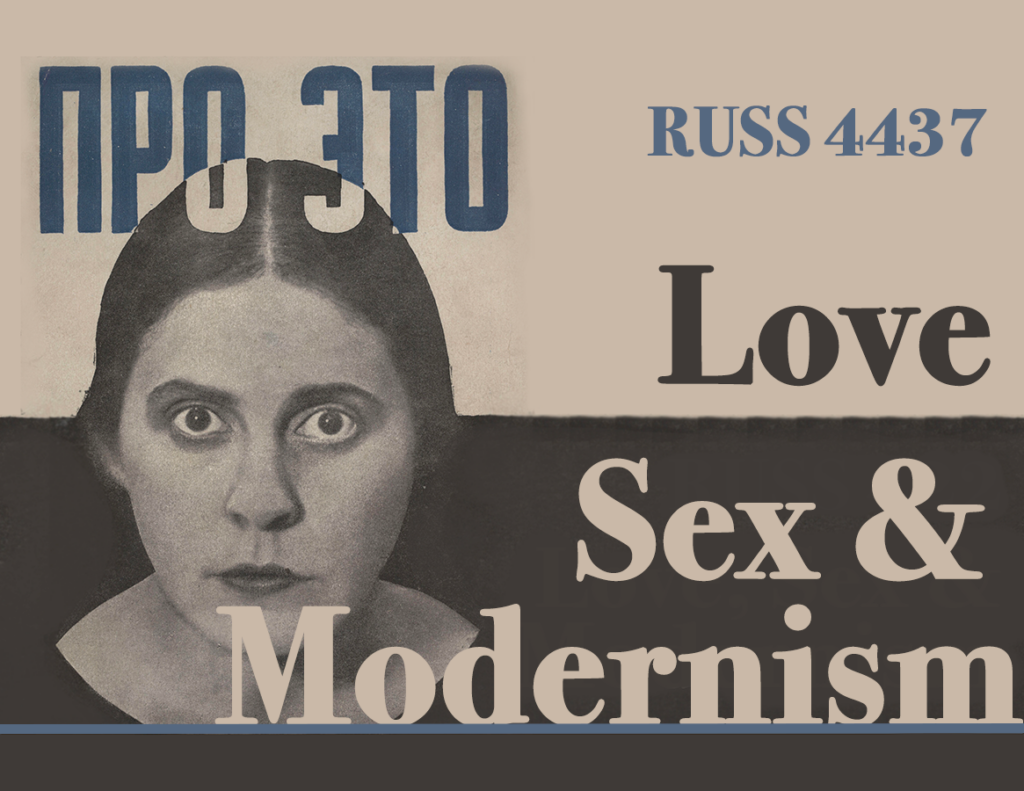
RUSS 4437: Love, Sex & Modernism
Prof. Irina Denischenko
TR 3:30–4:45 PM
Course Taught in English
At the turn of the 20th century Russian culture witnessed unprecedented experimentation in regard to romantic and erotic relationships, gender identity and expression. Many cultural figures rejected procreative sex, traditional gender roles and identities in favor of less individualistic, less binary alternatives, with the hope of uniting humanity into a tight-knit collective and transforming the world. In this course we will consider not only the Russian modernists’ idealistic projections of future alternatives, but also the problematic pathologies that went hand in hand with their erotic utopias. This course examines literature, visual and performance art created between 1889 and 1930, with a focus on romantic relationships, sex, gender, and how these issues bridge pre-revolutionary and Soviet Russian culture. Alongside novellas, poems, essays, and visual art, students consider writers’ and artists’ personal biographies through the lens of “zhiznetvorchestvo” or the modeling life as a work of art. (HALC)
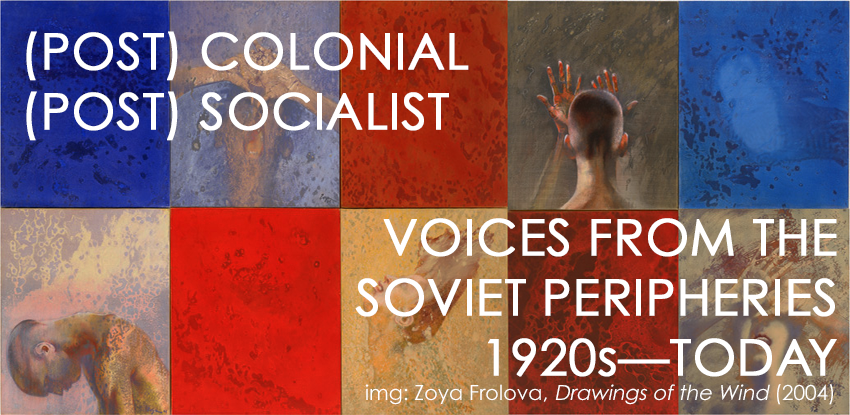
RUSS 4389: (Post)-Colonial / (Post)-Socialist
Prof. Bradley Gorski
TR 11:00 AM–12:15 PM
Course Taught in English
A geographically expansive view of Soviet and post-Soviet literature that reaches beyond the traditional centers of cultural production to invite voices and perspectives from across what the Soviets touted as “one-sixth of the world.” This course views the Soviet Union and Russia as multi-national, multi-ethnic entities, continuously resistant to monolithic definitions, readings, and interpretations. Authors from the Caucasus, Central Asia, and Siberia examine the colonial legacy of the Russian empire and the Soviet Union in the context of global postcolonial theory. Through close readings, we pay careful attention to the ethics of representation. We are especially concerned with voices: who is allowed to speak, under what conditions, to whom and on behalf of whom? These sets of concerns help develop, first, a structural understanding of narrative texts, and second, an ethical relationship to our material and to our own position as readers. (3 credits; HALC)
Polish
- PLSH 1001: Beginning Polish I (3 credits)
- MWF 12:00–12:50 PM – Iwona Sadowska
- PLSH 1501: Intermediate Polish II (3 credits)
- MWF 9:00–9:50 AM – Iwona Sadowska
Russian
- RUSS 1011: First-Level Russian I (6 credits)
- MTWRF 10:00 AM + F 11:00 AM – Jill Neuendorf & Anna Pechnikova
- MTWRF 2:00 PM + F 3:00 PM – Iwona Sadowska & Svetlana Moser
- RUSS 1012: First-Level Russian II (6 credits)
- MTWRF 12:00 PM + F 11:00 AM – Jill Neuendorf & Anna Pechnikova
- MTWRF 12:00 PM + F 11:00 AM – Jill Neuendorf & Anna Pechnikova
- RUSS 1511: Second-Level Russian I (6 credits)
- MTWRF 11:00 AM + F 12:00 PM – Jill Neuendorf & Elena Boudovskaia
- MTWRF 3:00 PM + F 2:00 PM – Iwona Sadowska & Svetlana Moser
- RUSS 1512: Second-Level Russian II (6 credits)
- MTWRF 9:00 AM + F 10:00 AM – Bradley Gorski & Anna Pechnikova
- MTWRF 9:00 AM + F 10:00 AM – Bradley Gorski & Anna Pechnikova
- RUSS 3001: Third-Level Russian I (3 credits)
- MW 12:30–1:45 PM – Olga Meerson
- MW 12:30–1:45 PM – Olga Meerson
- RUSS 3003: Russia(n) in Context (3 credits)
- TR 2:00–3:15 PM – Jill Neuendorf
This course focuses on oral proficiency. A variety of materials—textbook, video and audio recordings, Russian literature selections and readings in the Russian press—will be used to develop the students’ ability to converse on daily topics and handle cultural, political and social issues in Russian life today.
- TR 2:00–3:15 PM – Jill Neuendorf
- RUSS 4005: Fourth-Level Russian (3 credits)
- MW 5:00–6:15 PM – Anna Pechnikova
The goal of the course is to enlarge students’ vocabulary and to develop their ability to conduct conversation and discussion on a variety of issues and topics that pertain to the use of the language in their future professions. Class discussions focus on contemporary issues and are based on articles from the Russian press, the Internet, and television programs.
- MW 5:00–6:15 PM – Anna Pechnikova
- RUSS 4006: Russian Through Culture (3 credits)
- MW 5:00–6:15 PM – George Mihaychuk
This course examines the sources of contested issues raised in the present Russian-Ukrainian conflict that were formed from the late 18th-century to the end of the imperial age. How did the two national narratives treat origins in Kyivan Rus, the issue of language, the relationship of empire and peoples, and cultural production. For the empire unity was at stake. For Ukrainians it was not merely existence as a distinctive people but an issue of esteem and worth. Students will analyze original Russian language texts of writers, scholars, and critics of the day. By engaging in oral and written work, they will enhance their vocabulary and language skills.
- MW 5:00–6:15 PM – George Mihaychuk
- RUSS 4097: Professional Russian I (3 credits)
- MW 3:30–4:45 PM – Elena Boudovskaia
Designed for graduate students in CERES and MSFS who will be using Russian in their professional lives, this course enhances participants’ command of the language in both the oral and written forms. The course focuses on preparation, delivery and discussion of oral presentations and written essays on topics related to the students’ professional interests. Topics range from international relations, politics and economics to Russian literature and popular culture.
- MW 3:30–4:45 PM – Elena Boudovskaia
Ukrainian
- UKRN 1001: Beginning Ukrainian I (3 credits)
- MW 12:30–1:45 PM – Elena Boudovskaia
- UKRN 2001: Intermediate Ukrainian I
- Tutorial, by permission of instructor – Elena Boudovskaia
- UKRN 4948: Advanced Ukrainian
- Tutorial, by permission of instructor – Elena Boudovskaia
Past and Future Slavic Department Courses
The Slavic Department offers a wide range of courses on an occasional and rotating basis. Browse the following categories to get a sense of what courses we have offered in the past and what we will offer again sometime soon.